

Wh Questions for Speech Therapy (Free Resources!)
WH questions for speech therapy are among the most common goals speech-language pathologists target in preschool through 4th grade. Many students with language delays, autism, auditory processing challenges, and mixed expressive-receptive difficulties struggle to understand what a question is asking and how to respond appropriately.
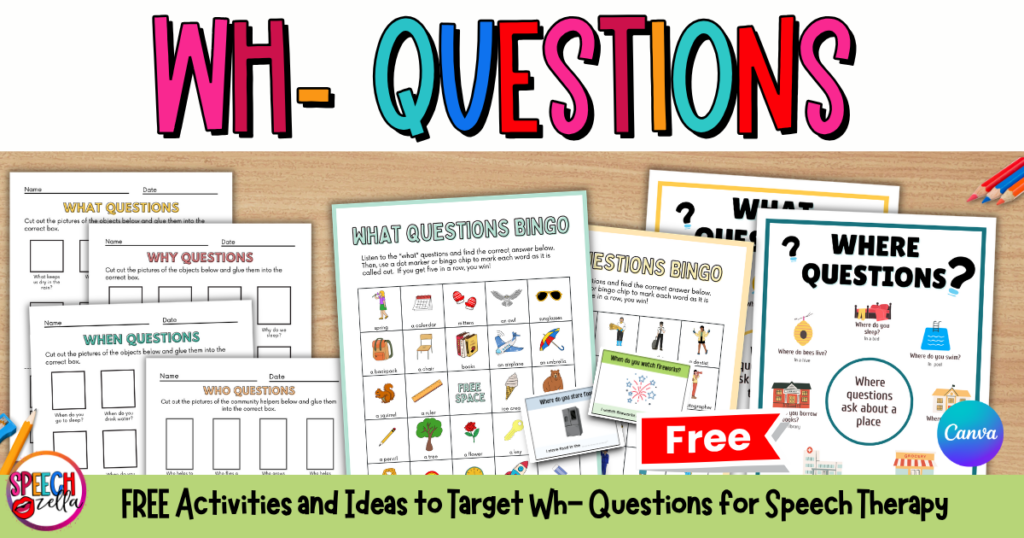
WH questions support:
- listening comprehension
- language comprehension
- vocabulary development
- sentence formulation
- social communication
- academic participation
Even older kids are expected to answer different types of WH questions all day long in the classroom. Teachers ask questions during reading lessons, conversations with peers, and during academic tasks. When students can’t answer WH questions, they often appear disengaged or unsure, even when they understand the topic.
Using structured materials such as Canva templates for speech pathologists can help students at different levels learn WH questions in a clear and visual way.
In this post, we will review:
- What the 7 WH questions are
- Examples of WH questions
- How to teach WH questions for speech therapy
- Free Canva for Education activities that support speech-language therapy goals
- Ways to differentiate activities from preschool through 4th grade
- Extension ideas to expand language learning
What Are the 7 WH Questions?
The 7 WH questions are:
- who
- what
- where
- when
- why
- which
- how
Each question type asks for different information. Students must understand the meaning of the question word before they can provide an appropriate response.
Why this matters for speech-language therapy goals
Students often memorize responses without fully understanding the structure of WH questions. Explicit teaching helps students learn how questions work and how to respond to specific questions across environments.
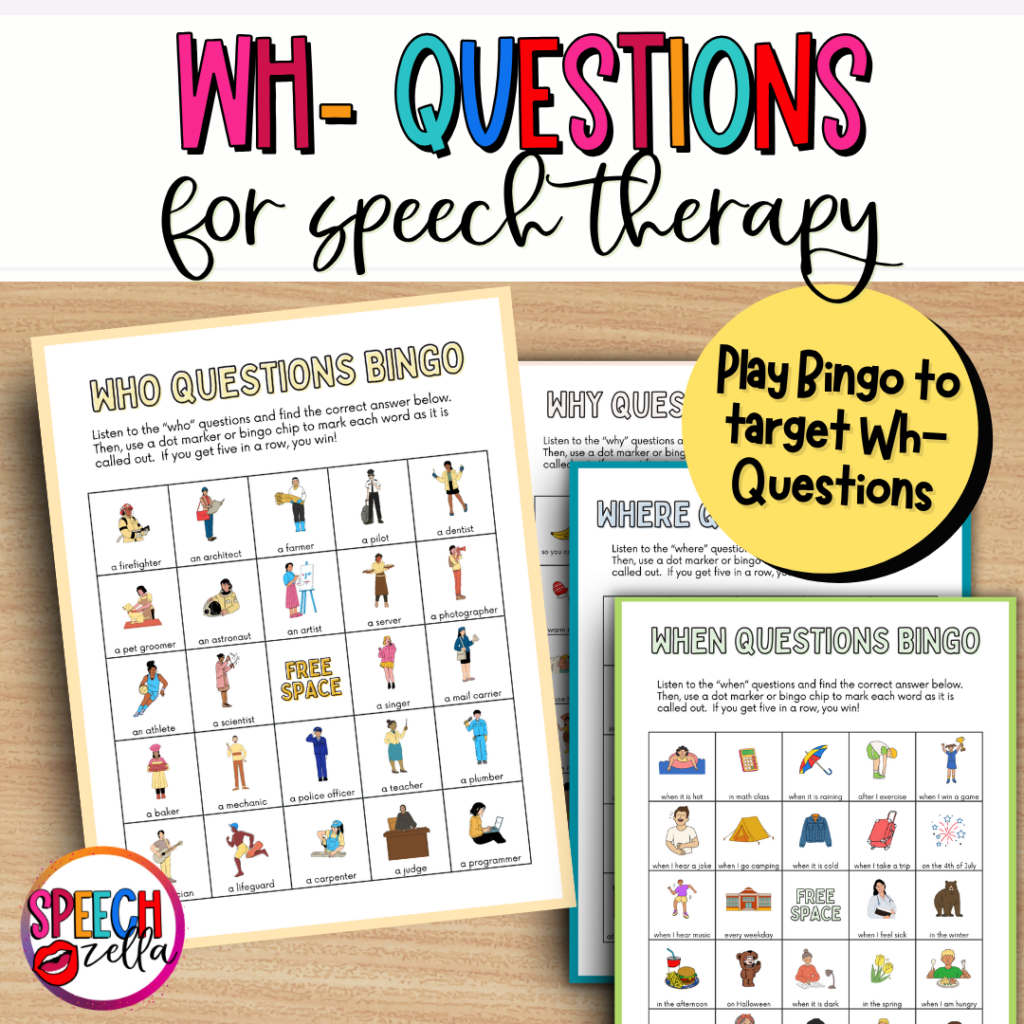
- Who asks about a person
- What asks about an object or action
- Where asks about a place
- When asks about time
- Why asks for a reason
- Which asks for a choice
- How asks about a process or method
WH questions for speech therapy are often introduced in a developmental order. Many SLPs begin with who and what questions because they are concrete questions before introducing more abstract questions, such as why and how.
How to Teach WH Questions for Speech Therapy
Teaching wh questions for speech therapy requires more than simply asking questions and expecting correct answers. Many students with language delays, autism, auditory processing challenges, or mixed expressive-receptive language needs do not yet understand what the question word is asking them to do. They may answer off topic, repeat part of the question, or respond with “I don’t know,” even when they have the vocabulary needed.
Students benefit from structured teaching that clearly explains what each WH question means and how responses should be organized.
Most students need:
- Visual supports
Pictures help students connect the question word to its meaning. For example, showing a picture of a firefighter helps students understand that who questions ask about a person. - Repetition
Students often need many opportunities to hear and practice the same question structure before the skill becomes automatic. - Structured practice
Activities that follow a predictable format reduce cognitive load and allow students to focus on understanding the question instead of figuring out the task. - Opportunities for expressive language
Students need practice saying answers out loud, not just pointing to pictures. This helps build sentence structure and grammar skills. - Explicit teaching of vocabulary
Students may not know the words needed to answer questions. Teaching vocabulary such as community helpers, actions, locations, and time concepts helps improve accuracy. - Practice answering questions in complete sentences
Expanding responses supports grammar, syntax, and overall communication skills.
I always tell my students to put the question back into their response. Providing models helps students learn how to organize their responses. For example:
- Therapist: Who helps keep us safe?
- Student: a police officer
- Therapist: A police officer helps keep us safe.
- Student: A police officer helps keep us safe.
Why visuals are especially important
Many students benefit from seeing the information presented clearly and consistently. Visual supports help students:
- understand what the question is asking
- reduce confusion
- focus attention
- improve recall
- organize language
When visuals are consistent across sessions, students begin to recognize patterns in WH questions.
Using Canva to Support WH Question for Speech Therapy
Using structured templates helps SLPs present information in a fun way that is easy for students to process. Canva for speech therapy allows therapists to create materials that are visually consistent, easy to modify, and engaging.
Benefits of using Canva for Education include:
- visuals can be quickly edited to match student interests
- consistent layout reduces cognitive load
- clear visuals support comprehension
- materials can be reused across sessions
- templates can be adapted for different grade levels
- supports efficient AI speech therapy lesson planning
Students learn the structure once and then practice applying the skill across topics.
answering wh questions speech therapy goal
These wh questions for speech therapy worksheets help SLPs target multiple speech language therapy goals at the same time. Because each set includes different activity types, students get repeated practice while working on both understanding and expressing language.
Skills that can be targeted
- answering WH questions
- listening comprehension
- vocabulary development
- grammatical structures
- inferencing
- social communication
- early literacy skills
Answering Wh- Questions Speech Therapy Goals
- Given visual supports, the student will answer WHO, WHAT, WHERE, WHEN, and WHY questions related to pictures or short stories with 80% accuracy across 3 consecutive sessions.
- Given a visual prompt, the student will respond to WH word questions using a complete 4–6 word sentence in 4 out of 5 opportunities across 3 sessions.
- Given verbal or visual clues, the student will identify the correct response to WH questions from a field of 3 choices with 80% accuracy across 3 consecutive sessions.
Using these wh questions for speech therapy printable worksheets is a great way to differentiate instruction while keeping therapy engaging. With Canva, it’s so easy to adjust the difficulty levels of your activities.
Why are Wh- questions important for academic success?
Students are expected to answer different types of questions throughout the school day. For example:
- Who is the main character?
- Who helped solve the problem in the story?
- Where did the story take place?
- How did the character resolve the problem?
- When do we use punctuation?
- When did the story happen?
Difficulty answering wh questions can affect reading comprehension, participation in discussions, and the child’s ability to follow directions. WH questions are used across subject areas, making them a high impact therapy target.
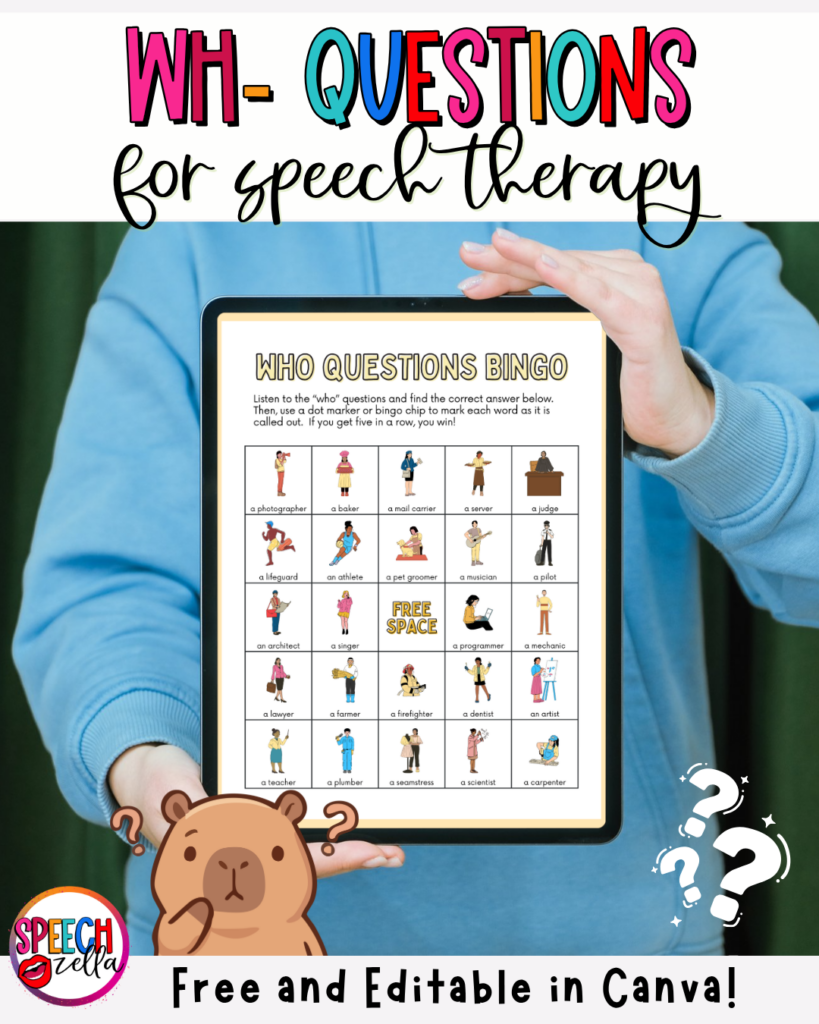
Practicing wh questions for speech therapy helps students:
- develop confidence when answering questions in both structured activities and natural conversations.
- understand spatial concepts and environments.
- understand how events are organized and how time words relate to meaning.
- develop critical thinking and language organization skills.
WHO Questions for Speech Therapy
WHO questions are often one of the first type of question introduced in speech therapy. These questions are typically easier for students to understand because they focus on people, which can be clearly shown using pictures.
WHO questions help students learn how language connects to real-life roles and relationships. These questions also support vocabulary development related to community helpers, family members, and everyday social interactions.
When teaching wh questions for speech therapy, WHO questions are a great starting point because the answers are usually concrete and easy to visualize.
Students learn that the answer to a WHO question will usually be:
- a person
- a job or occupation
- a family member
- a community helper
- a character in a story
Students begin to understand that the word who signals that the answer will be a person.
For many students, especially those with language delays or on the autism spectrum, explicitly teaching the meaning of the word who improves comprehension and accuracy when answering questions in the classroom.
Canva Templates for Who Questions
WHO questions provide an excellent foundation for teaching other WH question types. Once students understand that WHO questions ask about a person, they are better prepared to learn more complex question forms, such as WHY and HOW.
Here are different activities to help you target these basic questions (all templates are editable in Canva for Education, allowing SLPs to customize vocabulary, visuals, and difficulty level).
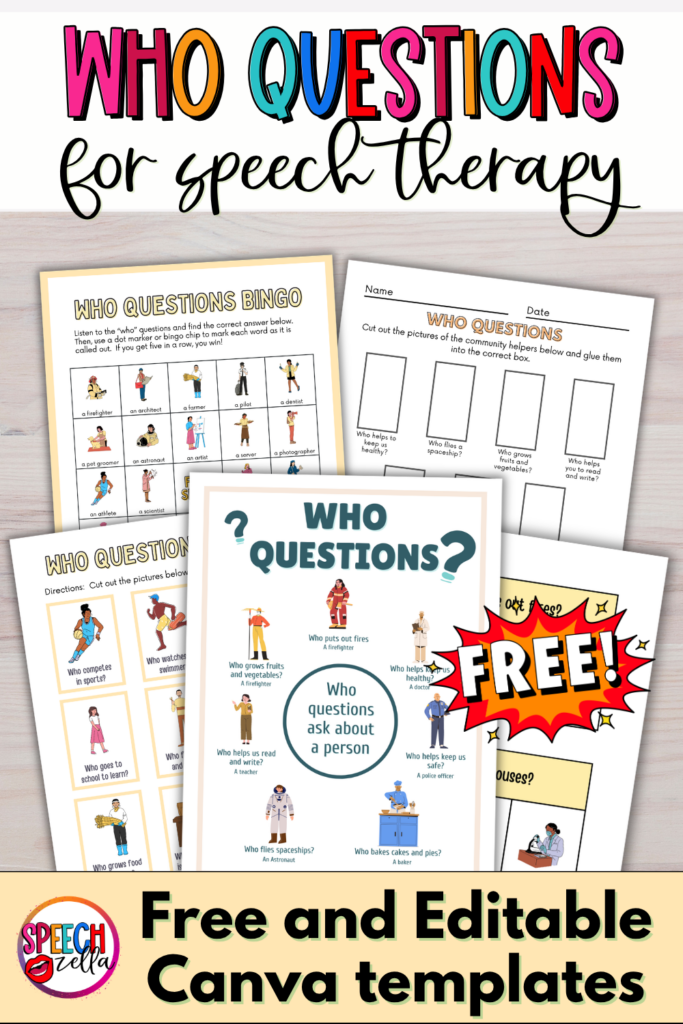
- Cut and Paste WHO Worksheet: Students match WH questions with the correct response.
- Bingo Boards for WHO Questions: Students listen to clues and identify the correct person on the bingo board.
- Multiple Choice Flashcards for WHO Questions: Each card presents a WH question with three answer choices.
- Who Questions Poster: This will help your students understand “who” questions.
- Matching Flashcards for WHO Questions: Use these flashcards in a fun game to target WHO questions.
WHEN Questions for Speech Therapy
WHEN questions focus on time concepts. These questions can be more challenging for students because time is not always visible. Students often need explicit teaching and repeated practice to understand when events happen.
WHEN questions help students understand how language connects to daily routines, schedules, and sequences of events. These questions also support vocabulary development related to time words such as morning, night, before, after, first, and last.
When teaching wh questions for speech therapy, WHEN questions are important because they help students describe events in an organized way. Understanding time concepts also supports comprehension of stories and classroom routines.
Students learn that the answer to a WHEN question will usually relate to:
- a time of day
- a daily routine
- a sequence word
- a day, month, or season
- something that happens before or after an event
For example:
- When do we eat breakfast?
- When do we go to sleep?
- When do we wear pajamas?
- When do we go to school?
- When do we brush our teeth?
Students begin to understand that the word when signals that the answer will relate to time. For many students, especially those with delayed language development or autism, time concepts can be abstract. Explicit instruction helps improve understanding of routines and sequences.
Canva Templates for WHEN Questions
WHEN questions help students develop stronger sequencing and comprehension skills. Once students understand that WHEN questions relate to time, they are better able to organize stories and describe events.
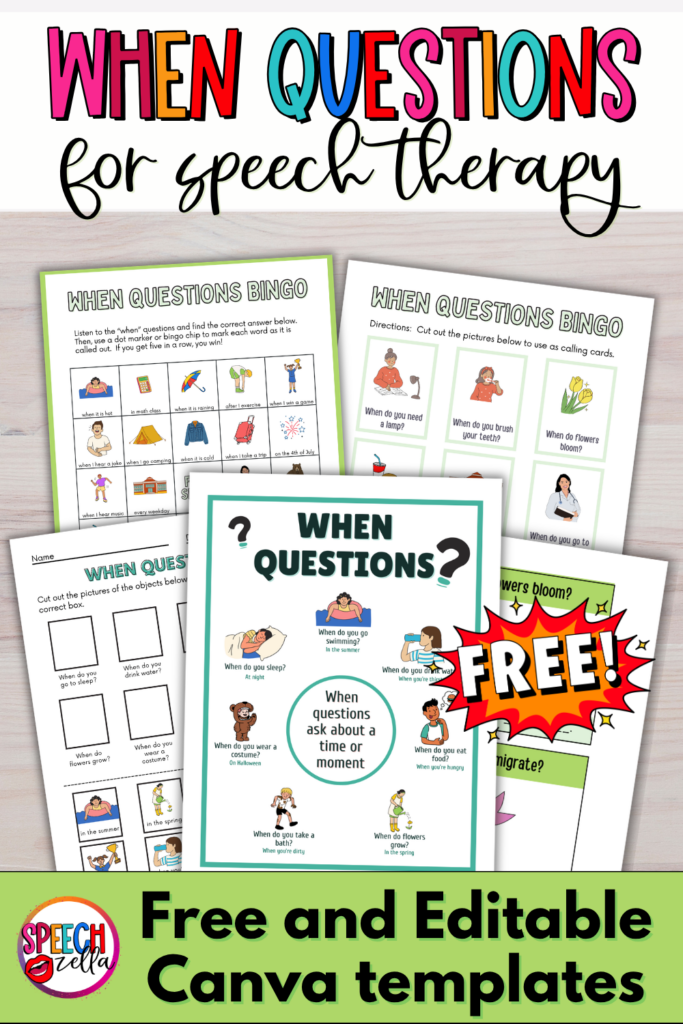
Here are some Canva templates to help you target WHEN questions (all templates are editable in Canva for educators, allowing SLPs to customize vocabulary, visuals, and difficulty level).
WHERE Questions for Speech Therapy
WHERE questions focus on location concepts. These questions help students understand where people, objects, and events are found. Because locations can often be shown using pictures, WHERE questions are usually easier for students to learn than more abstract question types.
WHERE questions help students connect language to real-world environments such as home, school, and community settings. These questions also support vocabulary development related to places and positional concepts.
When teaching wh questions for speech therapy, WHERE questions are helpful because students can often use visual cues to identify the correct response.
Students learn that the answer to a WHERE question will usually relate to:
- a place
- a building
- a room
- a setting in a story
- a positional concept
For example:
- Where do we sleep?
- Where do we buy food?
- Where do fish live?
- Where do we play outside?
- Where do we keep our clothes?
Students begin to understand that the word where signals that the answer will describe a location.
For many students, especially those with language delays or autism, explicitly teaching location concepts improves comprehension and accuracy when answering questions in therapy and in the classroom.
Canva Templates for WHERE Questions
WHERE questions support vocabulary related to places and settings. Once students understand that WHERE questions describe location, they are better prepared to answer questions about stories, routines, and real-life experiences.
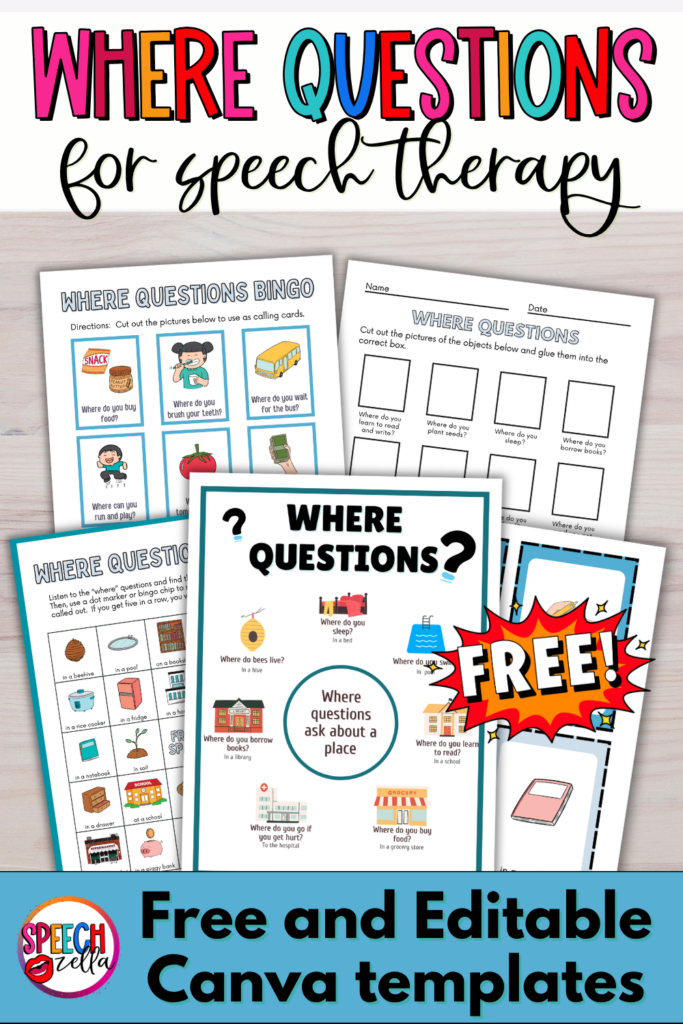
Here are some Canva templates to help you target WHERE questions (all templates are editable in Canva for educators, allowing SLPs to customize vocabulary, visuals, and difficulty level).
WHAT Questions for Speech Therapy
WHAT questions focus on objects, actions, and ideas. These questions are very common in both conversation and classroom instruction. Students often encounter WHAT questions throughout the day, making them an important skill to practice in the therapy room.
WHAT questions help students learn how language connects to everyday vocabulary and actions. These questions support understanding of nouns, verbs, and basic concepts that are used across many school activities.
When teaching wh questions for speech therapy, WHAT questions are helpful because they often involve familiar items and actions that students see regularly.
For example:
- What is the girl eating?
- What do we use to write?
- What is on the table?
- What is the boy doing?
- What do we wear when it rains?
Students begin to understand that the word what signals that the answer will describe a thing or an action.
For many students, especially those with language delays or autism, explicitly teaching the meaning of the word what improves vocabulary development and question comprehension.
Canva Templates for WHAT Questions
WHAT questions support vocabulary development and understanding of actions. Once students understand that WHAT questions relate to objects or actions, they are better prepared to answer questions in both structured activities and classroom lessons.
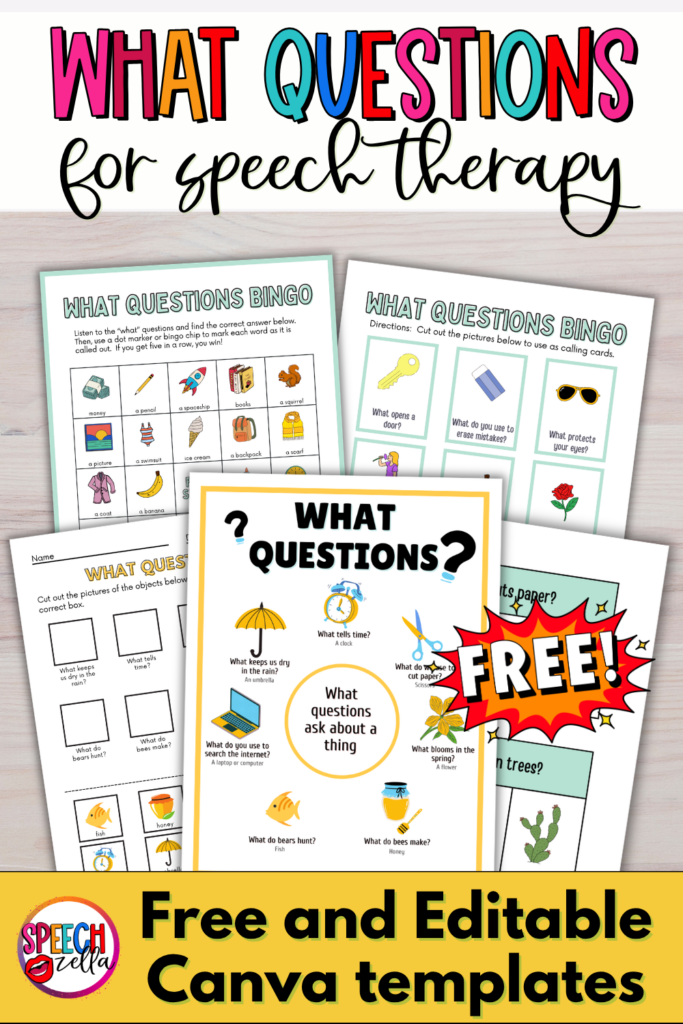
Here are some of my favorite resources / Canva templates to help you target WHAT questions (If you want to differentiate your lesson, then grab these editable activites in Canva for Education).
WHY Questions for Speech Therapy
WHY questions focus on reasons and explanations. These questions are often more challenging for students because they require more than just labeling a picture. Students must think about cause and effect and explain why something happens.
Additionally, WHY questions help students develop reasoning skills and higher language level understanding. These questions support vocabulary related to emotions, problem solving, and everyday situations.
When teaching wh questions for speech therapy, WHY questions are typically introduced after students understand more concrete question types such as who, what, and where.
Students learn that the answer to a WHY question will usually relate to:
- a reason
- a cause
- an explanation
- a problem and a solution
- an emotion or motivation
For example:
- Why do we wear coats?
- Why do we brush our teeth?
- Why is the girl crying?
- Why do we bring an umbrella?
- Why do we go to school?
Students begin to understand that the word why signals that the answer should explain a reason.
For many students, especially those with language disorders or autism, WHY questions can feel abstract, and they struggle to answer these complex questions. Explicit teaching helps students connect actions with reasons.
Canva Templates for WHY Questions
WHY questions support reasoning and explanation skills. Once students understand that WHY questions ask for a reason, they are better able to describe events and explain ideas.
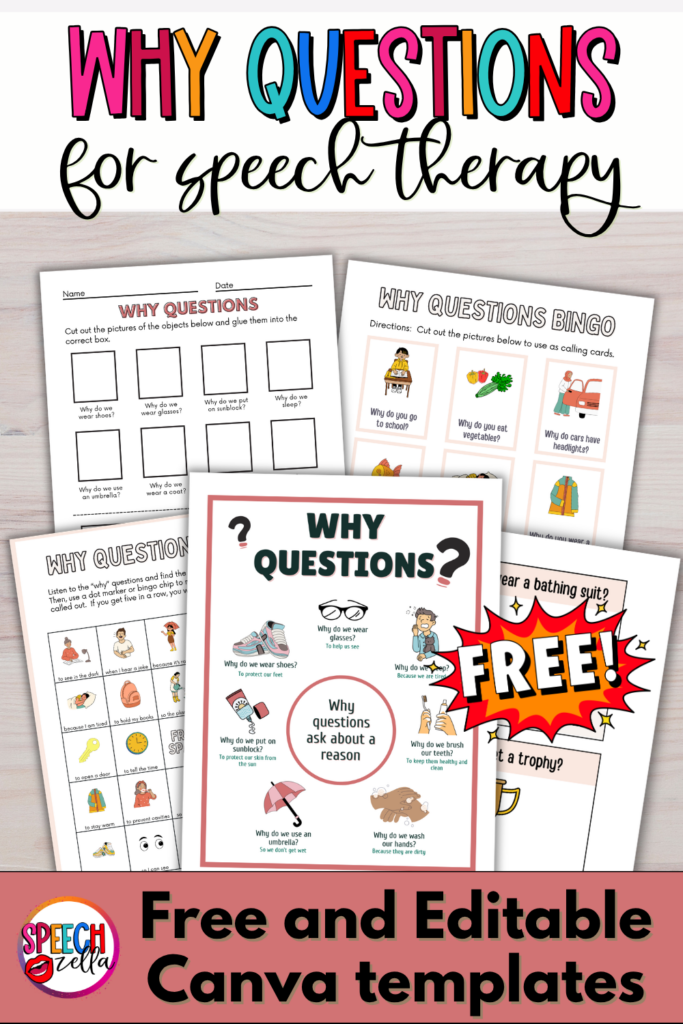
Here are some Canva templates to help you target WHY questions (all templates are editable in Canva, which allows SLPs to customize vocabulary, visuals, and difficulty level).
Final Thoughts on WH Questions for Speech Therapy
WH questions for speech therapy support language skills that students need for academic success. The resources included in this post helps you target wh- questions with resources for lots of practice.
Using structured materials, visuals, and repetition helps students build confidence when answering questions, so make sure you grab your free resources in Canva today!
Become a Canva Educator
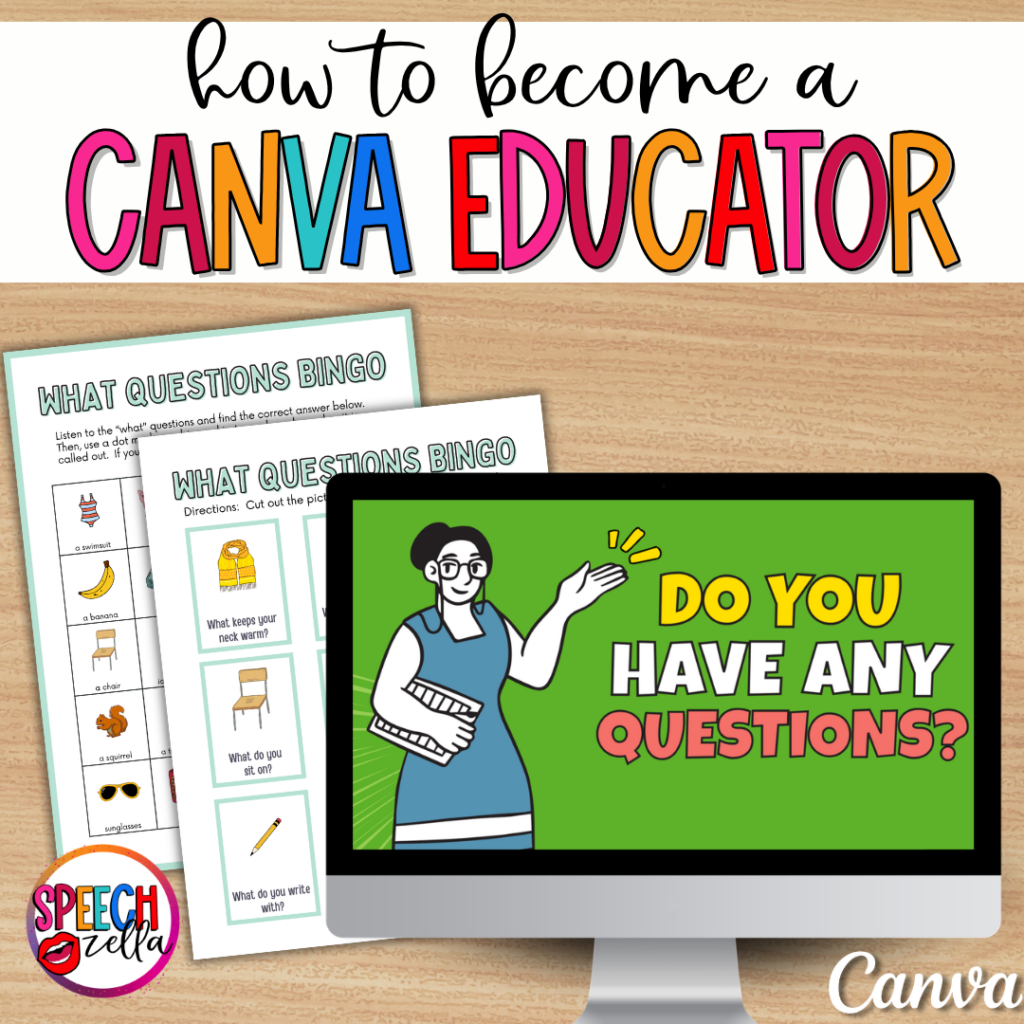
You’ll get notified of all the new free Canva templates for SLP plus get exclusive access to a full library of free resources.