

How to catch a yeti activities for speech therapy
How to Catch a Yeti activities are fun in speech therapy because they are both silly and mysterious. They feel playful and fun for kids of all ages. Keep reading below to get all the free activities today!
Through a kid’s eyes, a Yeti is just real enough to imagine and just ridiculous enough to feel safe, and creates an optimal experience for language learning- especially during the winter season when motivation can dip.
Winter can feel like the longest stretch of the school year. By the time students return from Christmas break, routines are off, energy is low, and attention is scattered.
As a school-based SLP, this is usually the moment when therapy sessions need a reset — something that feels new, playful, and motivating, without adding hours of prep.
If you want to get to the good stuff, here are all the links to the resources:
- Yeti Reading Comprehension
- Yeti vs. Bigfoot Reading Comprehension Activities
- Yeti Fact Sheet Activities
- Preposition Flashcards
- Simple Yeti Reading Comprehension Passage
- Guess the Yeti's Word
- Brain Break Flashcards – Yeti Themed
Why Use this book for Speech Therapy?
In this blog post, I’m sharing how I use How to Catch a Yeti as a flexible and my yeti book companion unit in speech and language therapy.
Teachers can use these activities in English language arts. You’ll see how this theme works in small group, group sessions, literacy centers, and whole class language lessons, with ideas you can actually use.
How to Catch a Yeti Activities for Speech Therapy
Why are yetis a great way to improve speech and language skills? Most kids are familiar with yetis, and so they’re more willing to describe, explain, infer, and predict what will happen. This is especially helpful for students working on expressive language and narrative skills during therapy sessions.
Because the story is full of hilarious hijinks and failed traps, it creates a low-pressure environment where kids feel safe taking risks.
You’ll find they are much more willing to share ideas or practice grammar when they’re genuinely entertained by the plot.
The advantage of a Yeti theme is that it’s great for all ages. It’s a hit for 1st grade and 2nd grade ELA, but it also works surprisingly well for middle and high schoolers. For older students who still need language support, the vibe feels ‘playful', making it much easier to get their buy-in.
If you want all the activities, make sure you download this book study unit today!
How to Catch a Yeti Book
“How to Catch a Yeti” by Adam Wallace is a picture book in the New York Times bestselling How to Catch series.
Using books from the same series is an effective strategy for targeting speech and language skills because it provides predictability and repetition that support learning.
Decreased Cognitive Load
When kids are familiar with a series’ format, such as the recurring theme to “Catch a” mythical creature using STEM traps, they don’t have to use as much mental energy to understand the storys structure.
This reduces the cognitive load, which helps students focus on more specific language targets, such as:
- Narrative retells
- Sequencing
- Comprehension questions
- Inferencing
- Problem solving
- Cause and effect relationships.
Support for Vocabulary and Grammar
This book series often repeats specific vocabulary words and sentence structure throughout the books, which helps students with:
- Retention: Students are more likely to learn and recall new words when they use and hear them multiple times in familiar contexts.
- Sentence Building – The recurring grammatical patterns help children understand and form sentences correctly.
When paired with a themed book companion that includes adapted book piece sets, visual supports, and visual answer choices, the story becomes accessible to a wide range of learners.
How to Catch a Yeti Reading Level
“How to Catch a Yeti” is perfect for lower elementary students in grades kindergarten through 2nd grade. However, you can also use this activity with older students to target inferencing and critical thinking skills.
Here are the reading level metrics:
- Guided Reading Level (GRL): L
- Lexile Measure: AD510L
This book is a great read-aloud for younger children because of its rhyming structure and engaging visuals.
How to Catch a Yeti Read Aloud
“How to Catch a Yeti” is a great book to use with early elementary students and can easily be read-aloud (even if you don’t have the book!).
Here are some great read-aloud options:
Author reading
Adam Wallace has an official video of him reading the story out loud.
Animated Versions
Some YouTube teacher-creators offer animated story read-alouds that bring illustrations to life.
First Time Reading the Book
The first time I read the book or show the video, I let the students watch the story all the way through so they can get the gist. No questions related to the story because I want the students to get the overall message before we do a deep dive into their goals.
However, I do like to target making predictions with the students during the first book reading. I will pause after each trap and ask questions, such as:
- Predict how the next trap will work?
- How will the yeti escape this trap?
Have your students look around the page for “hidden” clues, such as footprints or white fur peeking out behind the rocks.
Reading the Book a Second (or Third!) Time
But, after the first session, I make sure to read the book again several times while working on their speech-language goals.
I might try presenting the story in different ways (e.g., the first time I read the book, but the next time I show the video).
I also read it a few more times in the next few weeks.
You can then pause the story to ask:
- “Why didn’t that trap work?”
- “What clue tells us how the Yeti feels?”
- “What do you think will happen next?”
These moments build critical thinking while keeping the session engaging.
Read alouds work well in small group, group sessions, and whole class language lessons, making them ideal for collaboration with teachers.
How to Catch Yeti Activities (Even Without the Book)
You don’t need the book to use these How to Catch Yeti activities effectively.
Students love imagining how they would catch a Yeti. If you read this book, asking students to imagine how they would catch a Yeti lets them practice:
- Creative writing
- Narrative pieces
- Planning and sequencing
- Describing and explaining
Some students design traps using a cardboard box, cotton balls, and simple paper creations.
Others build snowy scenes with polar bears or icy caves inspired by the abominable snowman legend. These hands-on activities support language while feeling like play.
How to Catch a Yeti Comprehension Questions
Here are some questions you can ask your students while you read this book out loud to target inference and critical thinking:
- Where does the yeti live, and how would you describe his “lair”?
- What was the first trap the kids tried, and what was the final one?
- How did the yeti manage to get away from the “Snatch-a-roo 3000”?
- Why were the kids so determined to catch the yeti?
- Why did the kids think using syrup and candy would be a good way to lure the yeti?
- Based on his actions, what words would you use to describe the yeti (e.g., clever, fast, playful)?
- How is the yeti in this story similar to or different from other legendary creatures you know, like Bigfoot?
- How do you think the yeti felt about being chased by the kids? How did the kids feel when they got trapped in a bubble?
How to Catch a Yeti Activities for Speech Therapy
I designed these How to Catch a Yeti activities to be a ‘forever resource' for your therapy closet. Rather than one-and-done worksheets, these are flexible tools built to be reused across different goals and service models. They’re designed to adapt and grow right along with your caseload, session after session.
These activities target:
- Language skills
- WH questions
- Comprehension questions
- Vocabulary
- Character traits
- Past tense verbs
Because they’re editable in Canva, you can adjust difficulty, create a half sheet, or print a full print version depending on your needs.
How to Catch a Yeti Activities for Speech Therapy
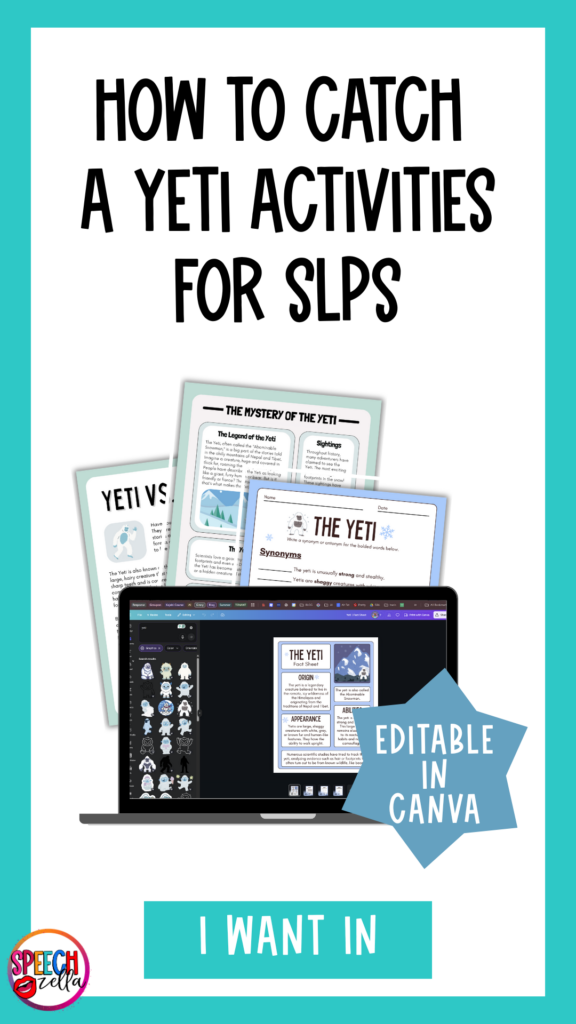
I have put together a variety of PDF activities you can use right away. Below is a detailed breakdown of each Yeti Canva template and exactly how I use it in speech therapy, language therapy, and even collaborate settings like English language arts and whole class language lessons.
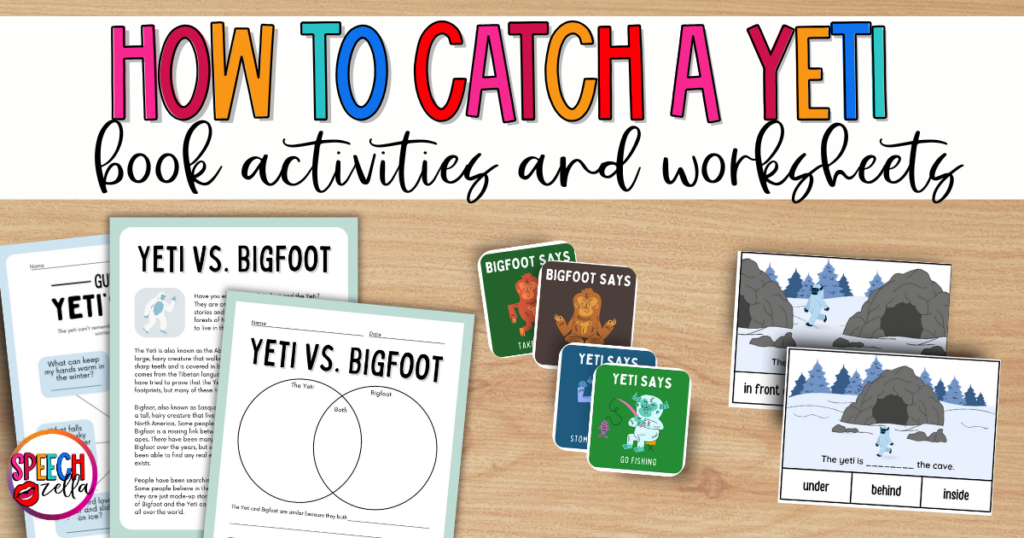
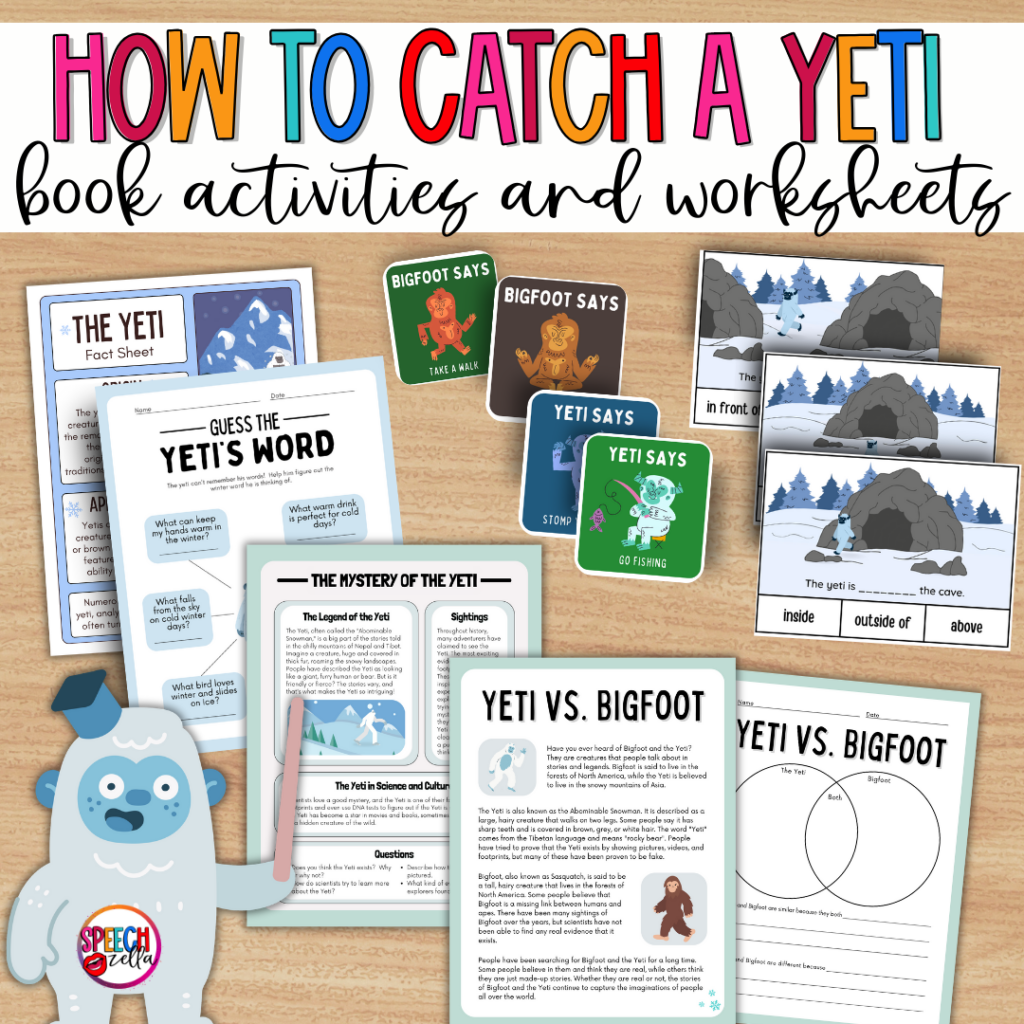
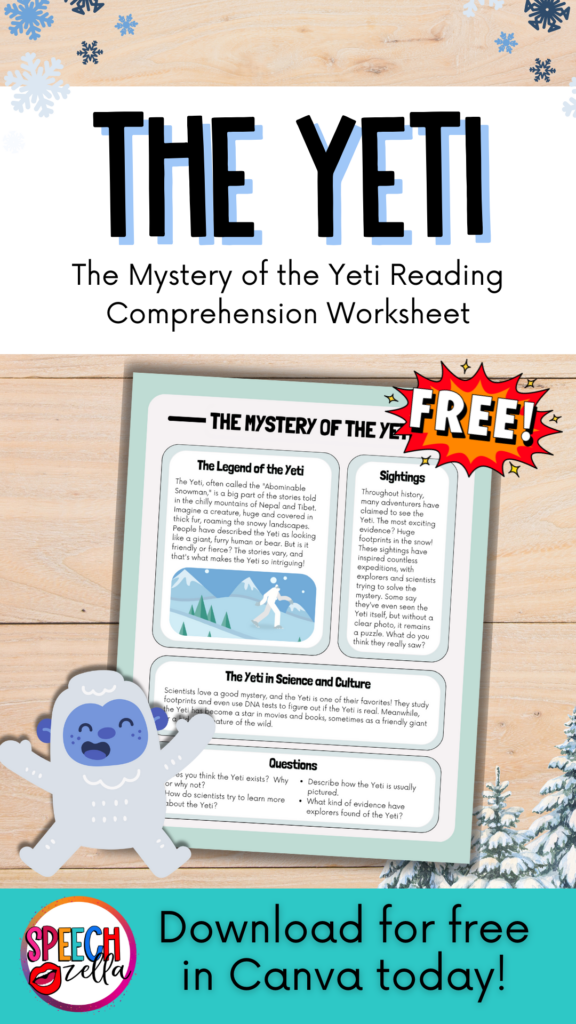
The Mystery of the Yeti: Reading Comprehension
This worksheet introduces the legend of the Yeti. It describes a huge, fur-covered creature that possibly roams the mountains of Nepal and Tibet and has never been caught.
This resource is a favorite for targeting reading comprehension and inferencing.
How I Use It in Therapy
This worksheet works well in small group sessions. I typically read the passage aloud first, so decoding isn’t a barrier.
Then we stop frequently to discuss the clues the text gives us about the Yeti.
For example, while reading the story, the students can wonder:
- Where the Yeti might be hiding
- Why hasn't the Yeti been caught yet
This is especially effective for older children, middle school, and even high school students who need inferencing practice but don’t want childish materials.
Target Goals
This activity focuses on reading comprehension and critical thinking. Students must identify details from the text and explain how scientists study the Yeti.
It also encourages students to form an opinion on whether the creature exists.
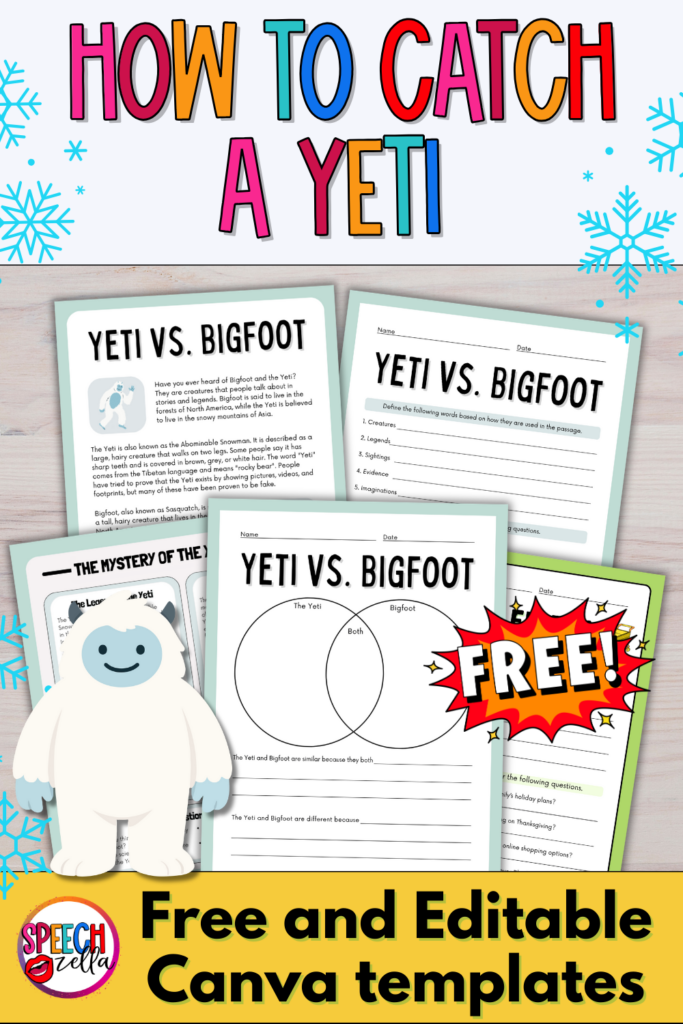
Yeti vs. Bigfoot Reading Comprehension Worksheet
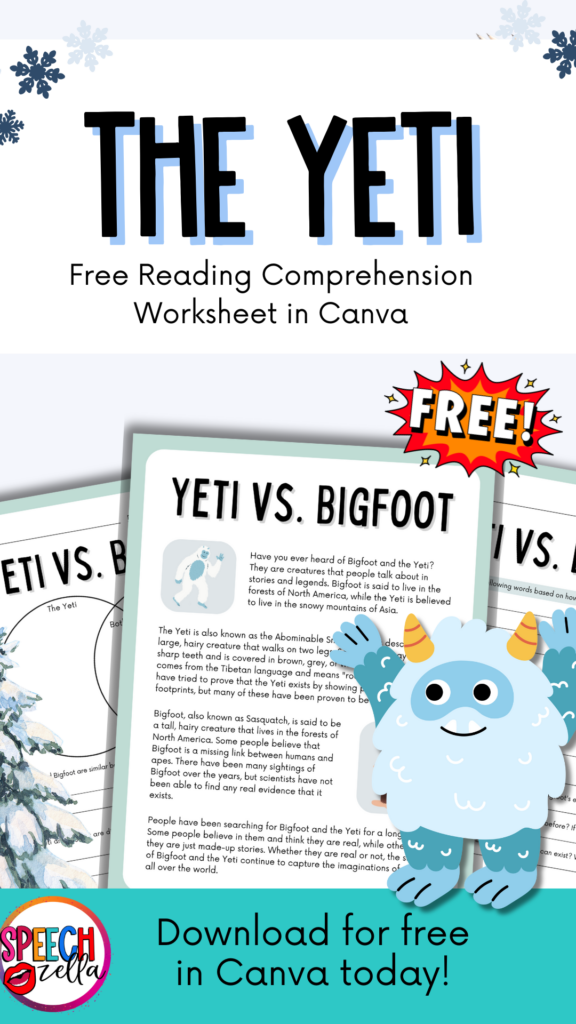
For students ready for more complex tasks, this worksheet compares the Yeti to its North American cousin, Bigfoot (Sasquatch).
How I Use This in Therapy
Students love mythical creatures, so comparing a Yeti and Bigfoot is really fun.
Students define Tier 2 vocabulary words like legends, sightings, and evidence. It includes a Venn diagram where students must list similarities and differences between the two creatures.
As with the previous activity, you can read the passage outloud first to decrease the need for decoding.
Then help the students find the answers to the provided questions and tasks by highlighting information from the text.
Target Goals
This worksheet targets vocabulary development, compare and contrast skills, and higher-level expressive language so help your students to build their vocabulary with this worksheet!
This resource also fits nicely into social studies discussions about folklore and Native Americans, making it a great option for collaboration with classroom teachers.
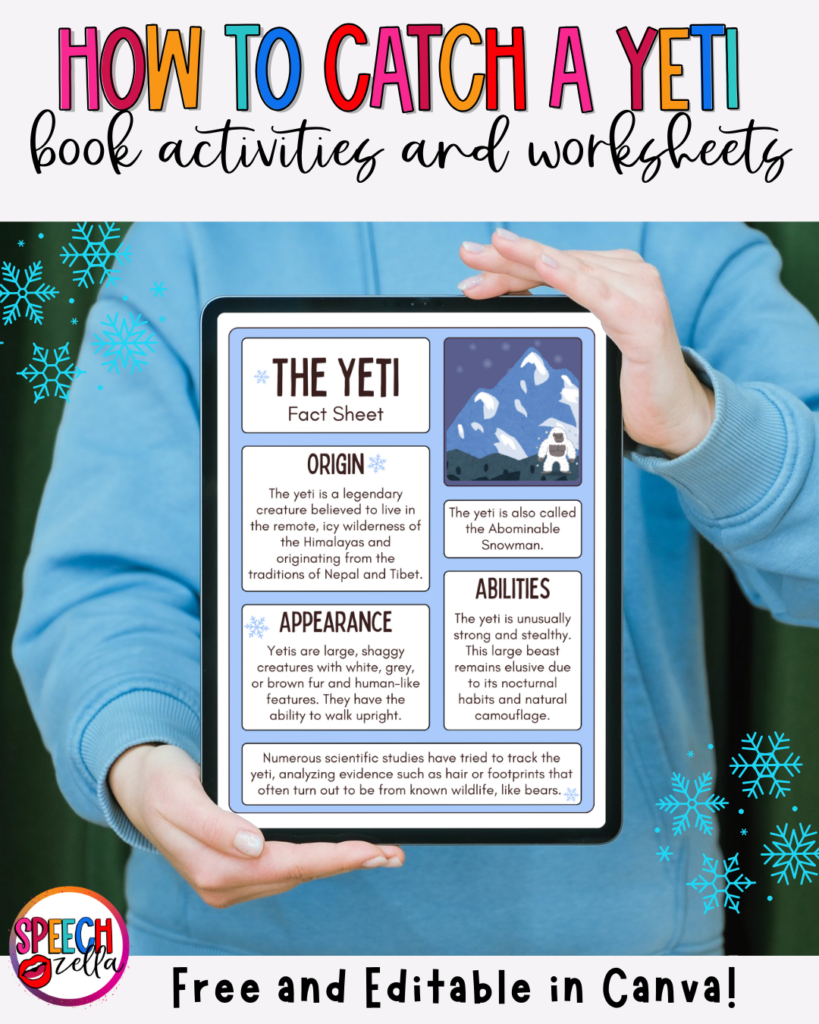
The Yeti Fact Sheet
If you're looking for a nonfiction resource, grab this fun fact sheet, which is perfect for older students and targets the main idea, supporting details, vocabulary, and more.
How I Use It in Therapy
Firstly, students will read a short, engaging worksheet on the yeti. The reading passage is easy to read, yet it includes many vocabulary words. It also connects nicely to physical science and winter themes, such as polar bears.
Target Goals
Here are the worksheet activities included:
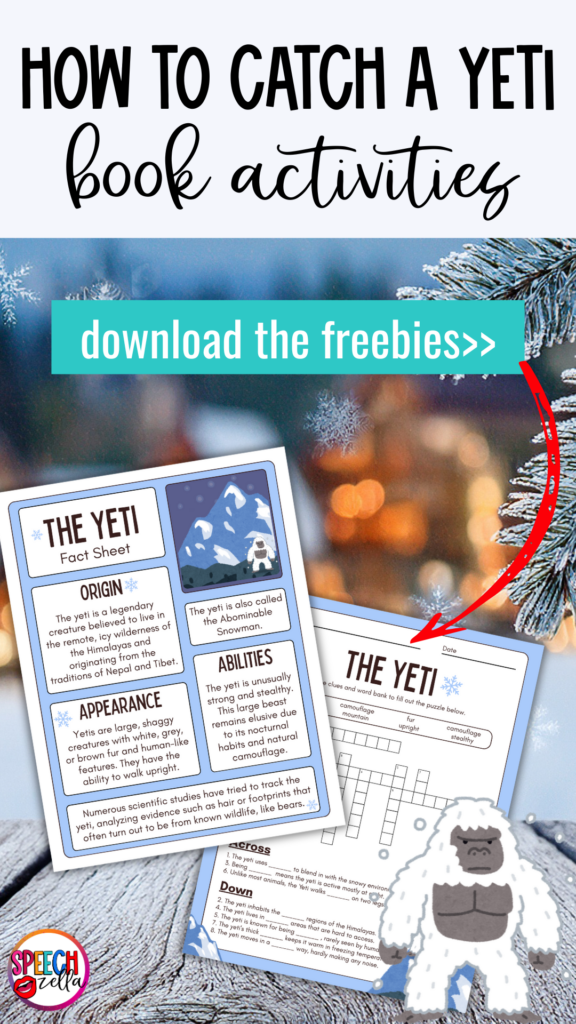
Synonyms and antonyms:
- Students find synonyms and antonyms for the vocabulary words highlighted in the passage.
- They will find synonyms and antonyms for words like elusive, stealthy, and nocturnal.
- This targets semantic skills and word relationships. Understanding synonyms (like shaggy for hairy) helps build a more robust internal dictionary for the student.
Describing Skills
- Target describing skills by describing the Yeti by category, function, location, and even more!
Identifying vocabulary words
- Students will learn the included vocabulary words by completing a crossword puzzle.
- This helps to target semantic skills.
- Students can then also work on expressive language skills by saying a sentence that describes the Yeti.
Yeti Prepositions of Place Flashcards
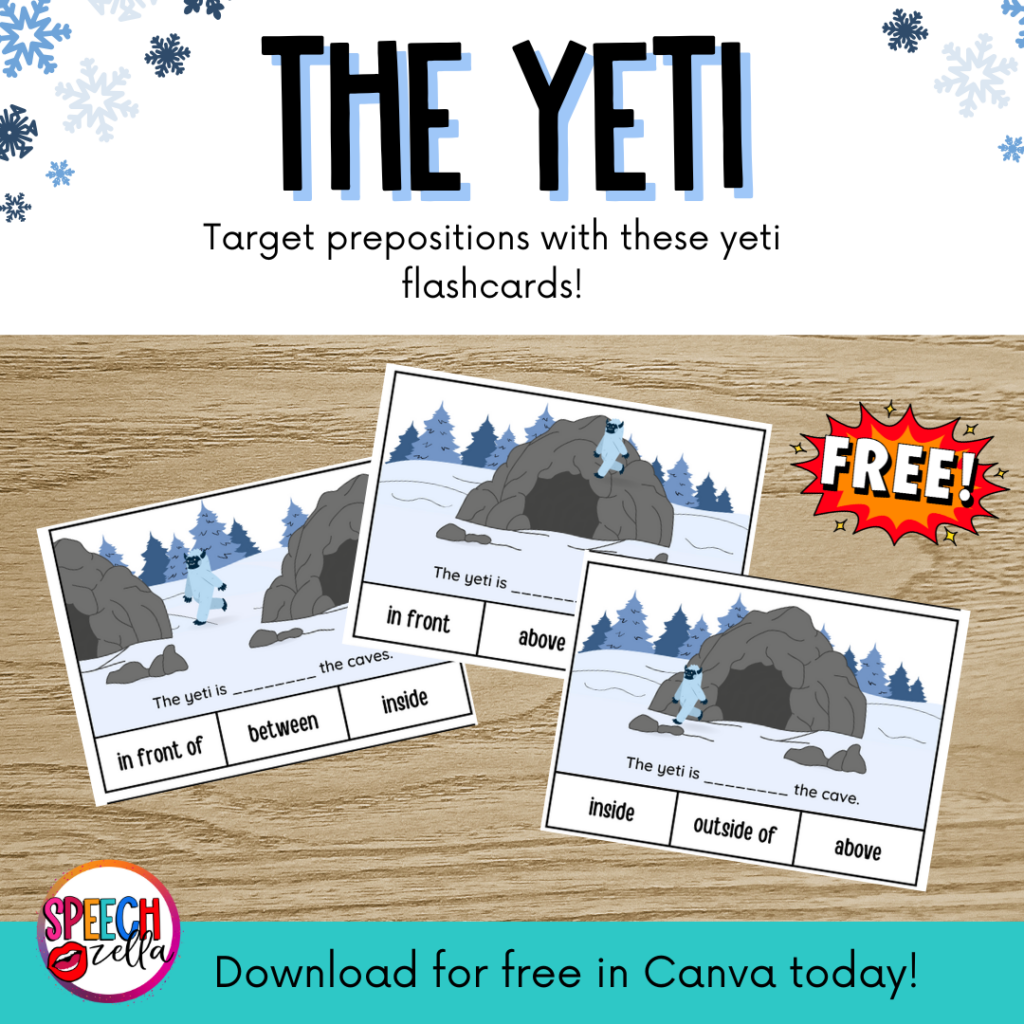
Spatial concepts are so important for following directions. These illustrated cards provide a visual way to teach preposition words, such as above, next to, between, and more!
How I Use It in Therapy
Examples include in front of, behind, inside, above, under, and between.
Each card shows a Yeti in relation to a cave.
Students look at the picture and select the correct preposition to complete the sentence.
Target Goals
This targets receptive and expressive language specifically related to spatial prepositions and basic concepts. It helps students who struggle with understanding “where” things are in their environment.
Yeti Adventures Writing Prompt
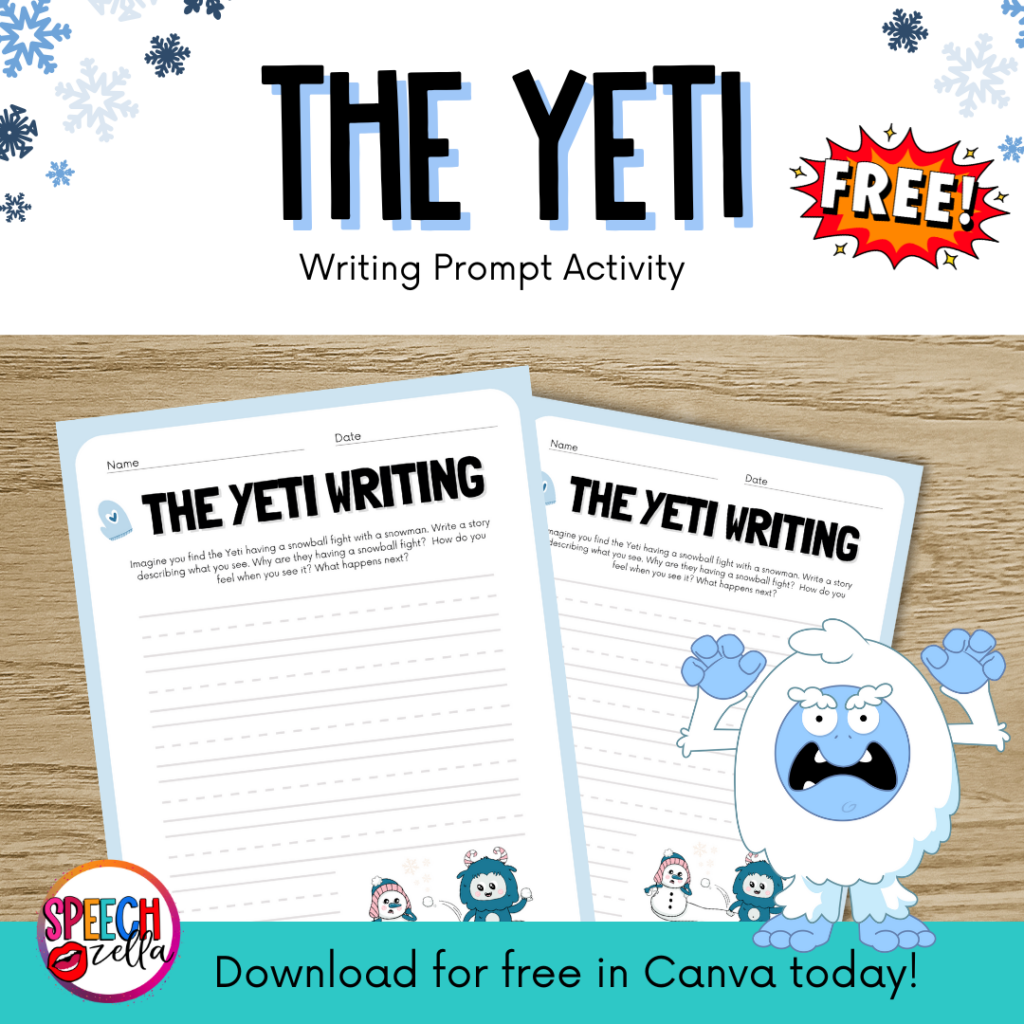
This worksheet helps to build narrative skills! It asks the student to imagine they have found a Yeti having a snowball fight with a snowman.
Some students draw first, then describe what’s happening. Others write sentences or short paragraphs.
How I Use It in Therapy
The student reads the writing prompt, then writes a story that describes the scene, explains why the fight started, and details what happens next.
Target Goals
This targets narrative sequencing, descriptive writing, and perspective-taking.
Students also must organize their thoughts into a beginning, middle, and end.
Simple Yeti Reading Comprehension Worksheet
This reading comprehension worksheet works well with younger students (grades 2-3).

How I Use It in Therapy
Firstly, the students read a short passage that explains how Yetis are reclusive and good at hiding.
It mentions that some sightings might actually be bears or the sound of the wind.
Read the paragraph to your students, then have them highlight the important information.
Target Goals
This targets identifying the main idea and answering “wh-” questions.
Guess the Winter Words Yeti Worksheet
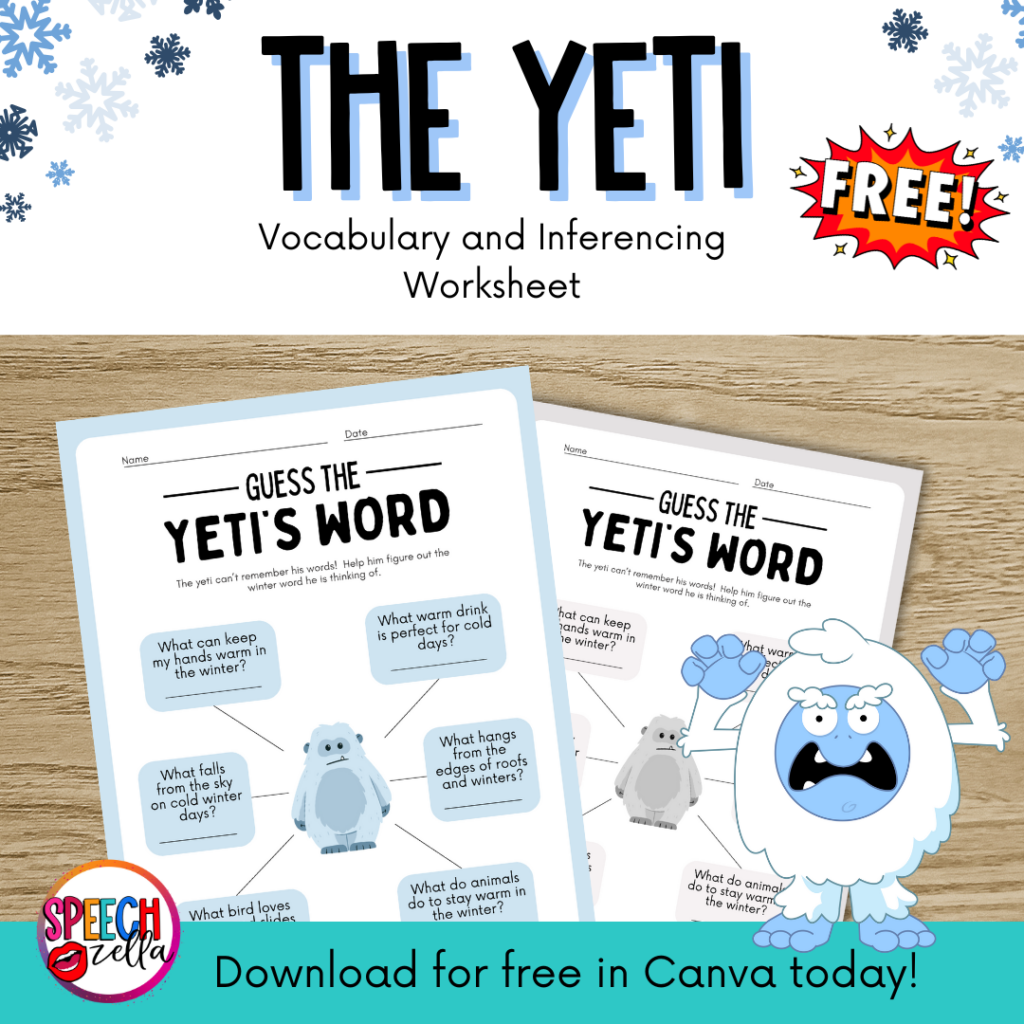
The yeti has forgotten all his words! Students have to help the yeti remember the right words. This Canva worksheet template targets vocabulary, describing, and even inferencing skills.
How I Use It in Therapy
You can use this with both groups and individual sessions.
The student reads the question and infers the winter word based on context clues.
After they make the guess, the student uses the word in a sentence or describes it by category and function.
For example, you can have them say:
- A [winter word] is a type of [category] that [function].
- Mittens are a type of clothing that keep your hands warm in the winter.
Target Goals
This activity targets inferencing, vocabulary, and describing skills! At the end of the session, I'll even have students create their own clues using vocabulary cards such as the ones included in this blog post:
Yeti Brain Break Flashcards
These yeti-themed flashcards give fun brain breaks to help students reset, process language, and stay regulated.

How I Use it in Therapy
Students reach into a paper bag, pull out a brain break card, and then lead the group in the movement.
For example, “Lick a popsicle like a Yeti.”
This is a great activity to use between activities or during transitions, especially if students have to sit for long periods.
Target Goals
Students act out silly movements, which supports:
- Gross motor breaks (great for physical therapy and occupational therapy, too!)
- Engagement
- Attention
You can target following directions and listening skills with these flashcards while also helping with self-regulation!
Sensory Extensions Using Yeti Templates
Many of these How to Catch a Yeti activities can be paired with sensory bins.
If you want to go beyond the worksheets and digital tools, I always recommend pairing these activities with a “Yeti sensory bin.”
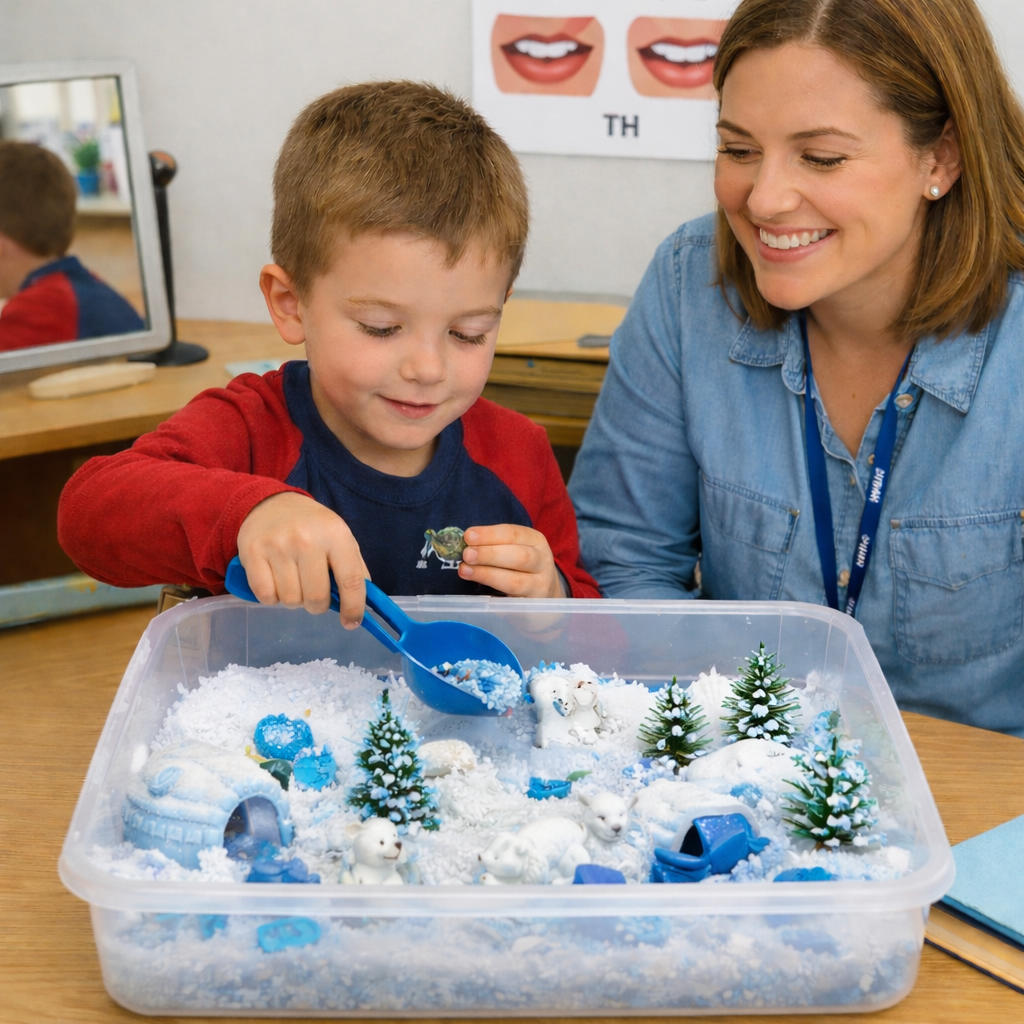
- Fill a plastic bin with cotton balls (snow), some blue glass gems (ice), and also a small Yeti toy.
- Add all the flashcards or picture cards with vocabulary words you want to target.
- Lastly, ask the students find the items in the bin.
Final Thoughts
If you want to bring fun and structure to your winter therapy sessions, then grab these How to Catch a Yeti activities.
They support speech, language, occupational, and physical therapy, as well as classroom instruction — all while keeping students engaged.
“How to Catch a ….” Book Companions
If you like these How to Catch a Yeti activities, check out these blog posts packed with ideas and resources to target the following books:
How to Catch a Leprechaun
How to Catch a Mermaid
How to Catch the Easter Bunny
Become a Canva Educator

You'll get notified of all the new free Canva templates for SLP plus get exclusive access to a full library of free resources.